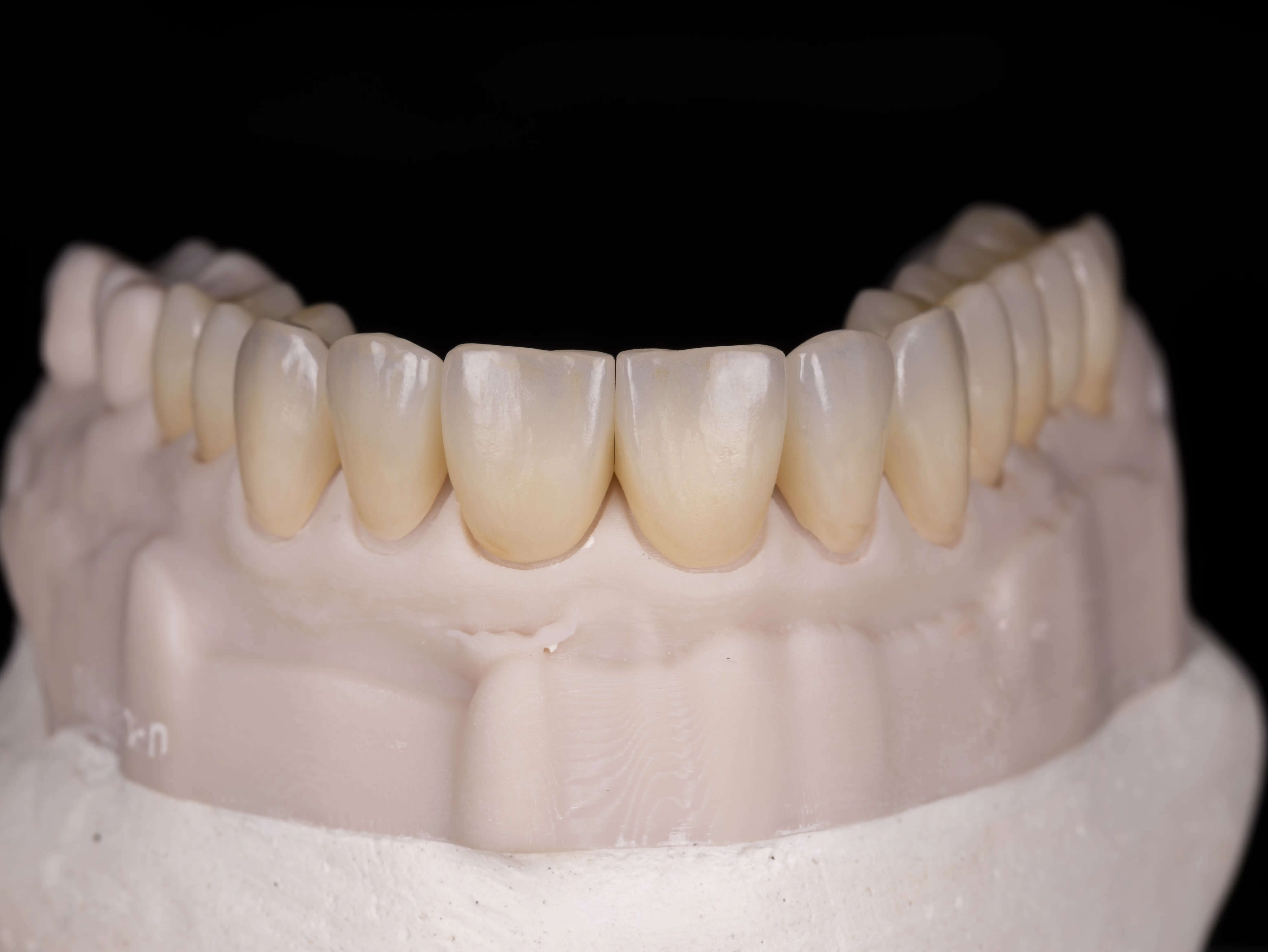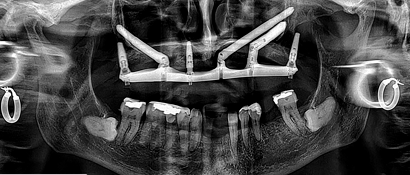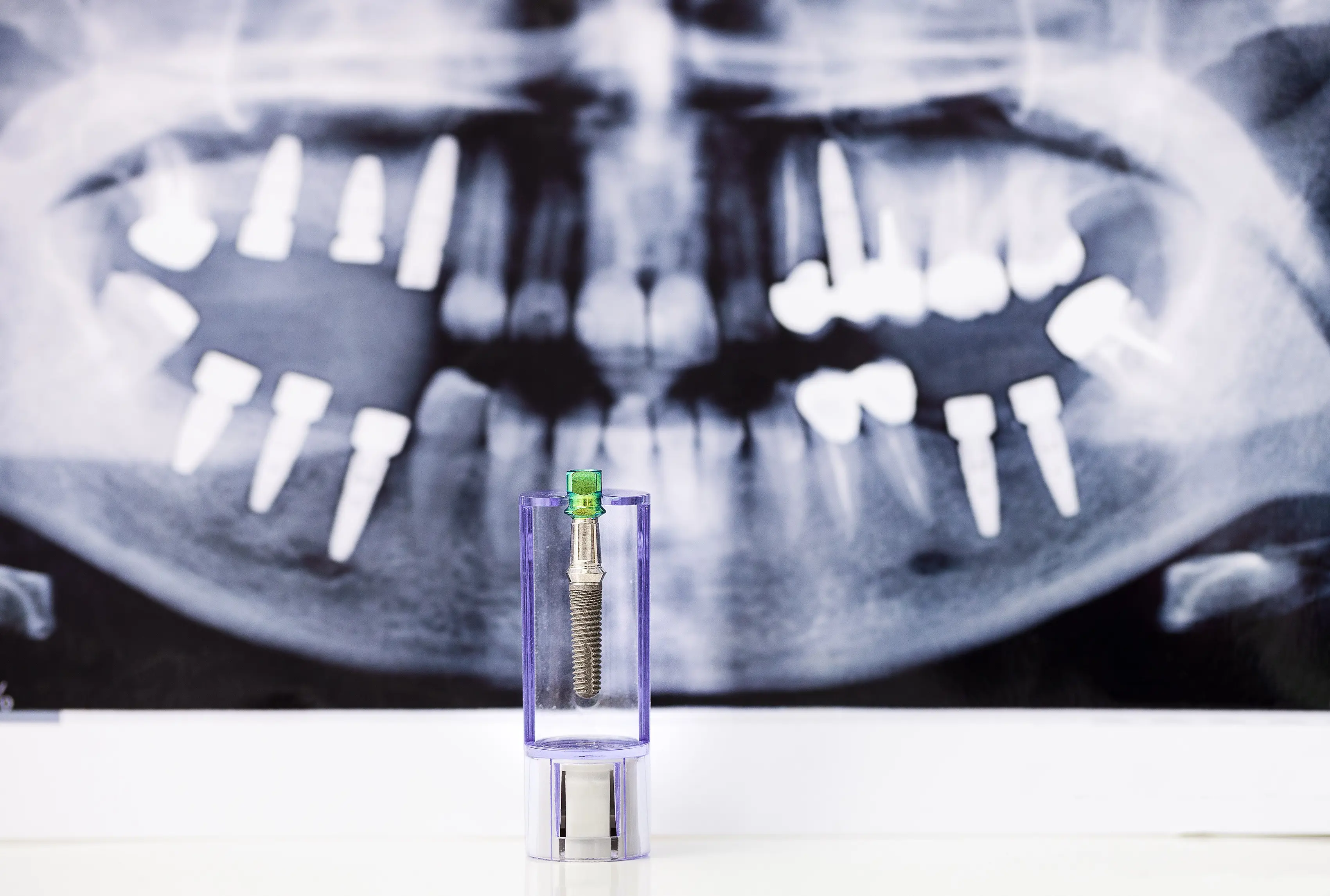

All-on-4 uses four implants to support a full arch of replacement teeth, while All-on-X allows for a customised number of implants - typically four to six or more - based on individual anatomy and clinical needs. Both approaches deliver fixed, non-removable prosthetic teeth, but they differ in implant placement strategy, cost, stability, and suitability for varying bone conditions.
Below is a detailed comparison to help you understand the clinical differences between these two full arch tooth replacement options.
All-on-4 vs All-on-X: Key Differences
The core distinction lies in standardisation versus customisation.
All-on-4 follows a fixed protocol using exactly four implants per arch, with two vertical anterior implants and two tilted posterior implants. It is designed to maximise existing bone and often avoids bone grafting procedures entirely.
All-on-X offers flexible implant numbers customised to individual patient needs. All-on-X can use more than four implants for stability, with placement tailored to bone structure, bone density, and bite force requirements.
Both solutions preserve jawbone density through implant stimulation and provide a permanent alternative to removable dentures. Choosing between All-on-4 and All-on-X depends on individual anatomical needs, oral health conditions, and treatment goals.
Number of Implants and Placement Strategy
The number of implants and how they are positioned within the jaw directly affects load distribution, the number of teeth delivered in your provisional and final bridges, long-term implant stability, and whether additional surgical procedures such as bone grafting are required. Having more than the minimum allowance for implants also allows for potential future proofing your prostheses, as in the event there was a failure late in the future, you may be able to continue with your bridge and function without needing to replace the failed implant.
All-on-4 Implant Configuration
All-on-4 uses four implants per arch for support - a standardised protocol that has been refined over decades. Two implants are placed vertically in the anterior region (typically near the canine positions), while two posterior implants are angled at 30–45 degrees. This angulation serves a specific biomechanical purpose: it engages available anterior bone volume while avoiding anatomical structures such as the maxillary sinus in the upper jaw and the inferior alveolar nerve in the lower jaw.
This strategic implant placement means the All-on-4 technique can avoid the need for bone grafting in many patients, even those with moderate bone loss in the posterior regions. The protocol uses fewer implants than traditional implants would require for a full arch, making it a streamlined dental procedure suitable for many patients with adequate bone density in the anterior jaw.
All-on-X Implant Flexibility
All-on-X allows for a customised number of implants - typically ranging from four to six, and sometimes more for complex dental issues. Rather than following a fixed template, the number of implants is determined by the patient's oral health, bone quality, bone volume, and functional demands.
All-on-X provides a personalised treatment approach based on anatomy. 3D imaging and digital surgical guides play a central role in planning, allowing the dental specialist to map implant sites precisely across the arch. This personalised approach means implant positions, lengths, diameters, and angulations are all tailored to optimise the patient's bone structure. In cases of significant bone loss or compromised bone density, additional implants or short implants may be used to distribute forces across more points of contact.
Stability and Load Distribution
How chewing forces are distributed across dental implants is one of the most important factors in long-term treatment success. Overloading individual implants can lead to mechanical complications, increased bone loss, and prosthetic failure.
All-on-4 Support Structure
The All-on-4 system provides excellent stability for eating and speaking when properly planned. Four implants distribute biting forces across the entire arch, with the tilted posterior implants reducing cantilever length and engaging dense cortical bone.
However, four implants means each individual implant carries a larger share of the total load. A 2024 finite element study comparing implant configurations found that designs using more implants produced lower maximum stress in cortical bone. Under heavy bite forces - such as those generated by bruxism or when opposing natural teeth - the load concentration on fewer implants increases mechanical risk. The All-on-4 system relies on strategic angulation and prosthetic framework rigidity to manage this, and for most patients with adequate bone height and normal bite forces, it delivers reliable long-term results.
All-on-X Enhanced Stability
All-on-X is typically recommended for stronger bite force distribution. Additional implants provide more support points across the arch, reducing the load on each one implant by roughly 30–40% compared to a four-implant configuration under the same bite force.
All-on-X enhances stability for patients with compromised bone density. Research comparing All-on-4 and All-on-6 designs found that six-implant configurations produced lower stress values in both cortical and trabecular bone under oblique loading. More implants also provide built-in redundancy: if one implant fails or loses integration, the remaining implants can still support the prosthesis. This is particularly valuable for patients with risk factors such as lower bone density, heavy occlusal forces, or parafunctional habits. All-on-X can improve longevity by distributing bite forces evenly across multiple implants.
Treatment Timeline and Healing Process
Both approaches follow a similar general sequence: diagnostic imaging, surgical planning, implant placement, provisional prosthesis, healing, and final restoration. The differences lie in surgical complexity and the number of implant sites that need to heal.
All-on-4 Treatment Duration
All-on-4 follows a streamlined protocol. Patients can receive provisional teeth on the same day as surgery - a process known as immediate loading - provided sufficient primary stability is achieved at each implant site (typically insertion torque above 35 Ncm). This means patients leave the surgical procedure with temporary teeth in place.
The typical timeline involves CBCT imaging and planning over one to two weeks, followed by a single surgery for extractions (if needed) and implant placement. Provisional prostheses are fitted the same day (or very soon after the surgery), with the final restoration delivered after three to six months once osseointegration is confirmed. This standardised approach enables predictable scheduling and a shorter overall treatment duration.
All-on-X Treatment Considerations
All-on-X treatment timelines vary based on the number of implants and complexity of each case. More implant sites means more osteotomies and more bone-implant interfaces that need to integrate. Where bone grafting is necessary to support additional implant placement in areas of insufficient bone, healing time extends accordingly.
Immediate loading is still possible with All-on-X when adequate implant stability is achieved across all sites. In fact, having more implants can sometimes make immediate loading safer because the total occlusal load is shared among additional support points. However, the customised planning phase - including advanced 3D imaging, surgical guide fabrication, and detailed biomechanical analysis - may add time before surgery. For patients with complex dental conditions requiring bone grafting procedures or sinus lifts, the overall timeline can be longer than a standard All-on-4 case.
Here at Axis Dental, we have streamlined the workflow for All on X using a complete digital workflow, and are able to ensure patients receive their custom made provisional bridge either on the same day as surgery or within 24-48 hours.
Cost and Investment Considerations
Cost is a significant factor in full arch restoration decisions. The financial comparison involves not only upfront surgical and material costs but also long-term maintenance and potential prosthetic replacement expenses.
All-on-4 Treatment Costs
All-on-4 costs 20–30% less than traditional implants. All-on-4 treatment ranges from $23,000 to $30,000 per arch, while traditional implants can cost $30,000 to $45,000 for a full arch. The savings come from using fewer implants, less surgical time, and the reduced need for extensive bone grafting.
A US cohort study comparing All-on-4 to conventional multi-implant protocols found the All-on-4 concept had a mean total adjusted cost of approximately $42,422 per jaw versus $57,944 for the conventional group - a saving of roughly $7,300 per jaw. All-on-4 typically avoids bone grafting, reducing overall costs further. Insurance may cover part of implant costs, varying by provider.
It is worth noting that prosthetic material choice significantly affects long-term costs. Acrylic bridges may need replacement every three to five years, while zirconia bridges can last ten to fifteen years or longer. The initial savings of an acrylic provisional should be weighed against future replacement expenses.
All-on-X Investment Requirements
All-on-X involves higher initial investment due to additional implants, more components (abutments, multi-unit connectors), and longer surgical time. Each extra implant adds fixture, surgical, and prosthetic costs.
However, evidence suggests that the additional implant support may reduce long-term maintenance costs for certain patient groups. In a retrospective study following patients over approximately 6.5 years, biological complications were approximately 10% in the All-on-4 group compared to approximately 1% in the All-on-6 group. Fewer complications means fewer unplanned dental visits, fewer prosthetic repairs, and potentially lower lifetime costs. For patients with risk factors who face higher probability of mechanical or biological complications, the upfront premium of additional implant support may represent better long-term value.
Something that sets Axis Dental apart, is that we believe patients are coming to us for a result, not a methodology. We want to deliver the best possible treatment, but want to give the peace of mind with financial transparency. That is why the number of implants are delivered based on position, bone availability and functional demands. We have a fixed cost whether 4 or 6 implants are placed once eligibility has been confirmed.
Patient Suitability and Candidacy
Patient-specific factors are central to determining whether All-on-4 or all on x implants is the more appropriate implant treatment. A comprehensive evaluation by a qualified dental professional should assess the following:
Bone density and volume: All-on-4 requires adequate bone density for implant placement in the anterior region. Patients with significant bone loss may still qualify for All-on-4 if anterior bone is sufficient, though those with severe bone loss across the arch or lower bone density may benefit from additional implant support through All-on-X. Bone grafting may be necessary for patients with insufficient bone volume.
Bite forces and opposing dentition: Patients with strong bite forces, bruxism, or natural teeth in the opposing arch place greater mechanical demands on implants. A cohort study of 217 patients found that All-on-6 was more predictable in patients who were elderly, had heavy bite forces, bruxism, or opposing natural dentition.
Systemic health factors: Smoking, uncontrolled diabetes, and osteoporosis increase the risk of biological complications. Studies show higher complication rates in All-on-4 when these risk factors are present. More implants may provide a safety margin in such cases.
Age: Elderly patients may have slower bone healing and varying bone densities. Evidence suggests that in older patients, additional implant support from All-on-X gives more consistent outcomes.
Budget and expectations: Ideal candidates for All-on-4 have good overall dental health and are seeking efficient, cost-effective treatment. Patients prioritising maximum durability and willing to invest in personalised treatment plans may prefer All-on-X.
Both All-on-4 and All-on-X are indicated for patients experiencing extensive tooth loss, losing multiple teeth, or those with failing dentition who need replacing missing teeth across one or both arches. An initial consultation involving CBCT imaging and clinical examination is essential for determining the most appropriate implant system.
All-on-4 vs All-on-X: Which Should You Choose?
Choose All-on-4 if you want a proven, cost-effective implant treatment with a standardised protocol. All-on-4 is ideal for patients with limited bone support in the posterior region but sufficient bone density anteriorly, who are seeking efficient full arch restoration with fixed teeth delivered quickly. It suits patients without major risk factors who want to minimise surgical complexity and cost.
Choose All-on-X if you need a customised treatment approach for complex bone conditions or enhanced stability. All-on-X benefits patients with compromised bone density, strong bite forces, bruxism, or those who are willing to invest in a personalised approach for optimal long-term outcomes. The extra implants reduce load per implant, provide redundancy, and may lower biological complication rates over time.
Both options provide excellent results when matched to appropriate candidates. Neither approach is universally superior - the right choice depends on your dental health, bone structure, functional demands, and treatment priorities. Professional consultation with qualified dental practitioners who can perform a comprehensive evaluation of your patient's oral health is essential for informed decision-making.